Hello everybody, welcome to our recipe page, If you're looking for new recipes to try this weekend, look no further! We provide you only the perfect Kimchi recipe here. We also have wide variety of recipes to try.
Before you jump to Kimchi recipe, you may want to read this short interesting healthy tips about {Easy Ways to Get Healthy. Getting A Healthy Eater
Healthy self esteem occurs from the environment found in thefamily, school, peer group, work place, and community. There are particular features of your environment that have to be current in order for self respect to be sabotaged and develop.
The principal component of a healthy atmosphere for self respect is the fact that it needs to be nurturing. It should offer unconditional warmth, love, and caring. It needs to give the realization that other people are known as deserving to be cultivated, reinforced, honored, and ensured to.
Healthy environment for self esteem transmits messages of warmth, loving, and affectionate by physical touch, meeting the survival needs of food, clothing and shelter, and providing a sense of stability and order in everyday life.
A healthy atmosphere for self esteem should provide acceptance. It will realize that other people see each other as deserving individuals who have a exceptional set of personality characteristics, skills, skills, and competencies making them special. Acceptance allows people to build relationships with others, nevertheless keep healthy boundaries of identity inside themselves.
In the healthy atmosphere for self esteem ought to be good communicating, everybody ought to be heard and reacted to in a healthy way so that healthy problem solving can be possible. Suitable giving and receiving of feedback will be encouraged and rewarded. Communication at a"feelings" level is a way of operation for all these people, allowing them to stay in touch with their emotions in a productive manner.
That comprehension and approval shouldn’t be based upon the condition that they must first conform to a prescribed standard of behavior or behavior. This is unhealthy. Unconditional recognition and acceptance contributed in the form of support makes it possible for people to reach their ultimate potential.
The healthy atmosphere for self esteem should be clearly defined and enforced limits known to individuals without the hidden tricks or manipulation. Limits enable individuals to recognize their duties and to chart their course of behavior in a reasonable way.
Respect and latitude for human action within the specified limits of this healthy atmosphere for self regard ought to be present as well. This encourages individuals to use their creativity, creativity, and creativity to be productive within the established structure. Restrictions that suppress identity can lead to a narrow focus, with people getting stunted and handicapped in the usage of the own skills, abilities, and tools.
Finally, healthy environment for self esteem should be bonding, that’s the physical/emotional occurrence between people and the others in their surroundings. This is essential for the development of healthy self esteem. This involves the significant additional giving unconditional love and assistance in addition to developing a psychological link between every other.
We hope you got insight from reading it, now let’s go back to kimchi recipe. To cook kimchi you only need 15 ingredients and 13 steps. Here is how you cook it.
The ingredients needed to prepare Kimchi:
- Prepare Salting the cabbage:
- Use 3 Chinese cabbages, each cut into half and then into quarters
- Prepare 2-3 cups coarse sea salt
- Use Water for rinsing Chinese cabbage
- Provide Kimchi paste:
- Use 1 brown onion, cut into quarters
- Use 5-6 whole cloves garlic (use more or less depending on preference)
- Provide 1-2 slices ginger (add more or less depending on preference)
- Prepare 2-3 Chinese pear (or use sweet and juicy gala or fuji apples), peeled and cut into chunks
- Prepare 2-3 tablespoons honey or sugar (use more or less depending in preference)
- You need 1/4 cup fish sauce (use more or less depending on preference)
- Get 1/4 cup Korean chilli flakes (these flakes are finer, use more or less depending on preference)
- You need 3 tablespoons Gochujang Hot Pepper Paste (use more or less depending on preference)
- Provide 1/4 cup water (may need to add more water)
- You need 4 spring onions finely sliced (to be added into paste at the end)
Steps to make Kimchi:
- For the cabbage, salting is the first process. Wash the cabbage, cut the cabbage in half and then each half into half again. Sprinkle coarse sea salt between the leaves of each cabbage starting from the bottom of the leaves where the stem is and working towards the top.
- Place salted cabbage in a large container with a lid and leave for 4 hours. Then turn the cabbage over and leave them for another 4 hours or over night. The cabbage are ready to be washed when you can bend the cabbage leaves without them snapping. Rinse the cabbage leaves a few times to wash of the salt properly and thoroughly.
- Thoroughly wash the cabbage in water about 3-4 times. Tip: each time the cabbage is washed it should be with fresh water. Tear a tiny piece of the cabbage leave to taste how salty it is. If the cabbage still taste salt wash a few more times to get rid of the remaining salt.
- Drain the cabbage using a colander and leave for an hour or so to get rid of any excess water on the leaves. In the meantime chop the spring onion sideways and place in a large mixing bowl and set aside.
- In a blender or food processor place the garlic cloves, onion, ginger, pear and blend together. Tip: If it does not blend add a tiny bit of water to start the process. Once ingredients are blended, it should be a smooth paste like consistency.
- Now add chilli flakes and fish sauce, honey, red pepper paste and water. Mix again until the paste now looks red. Give it a taste and adjust if needed (add more honey if you prefer it sweeter, chilli flakes or red pepper paste to make it hotter or fish sauce for saltiness etc). Tip: the paste should be a nice consistency so it's spreadable. Paste should not be too thick or thin (runny).
- Pour the paste into the large mixing bowl with the finely cut spring onions. Mix everything well together and ensure everything is evenly distributed and coated.
- Now it is time to coat each individual cabbage leaves with the paste. Tip: best for this part to wear some rubber gloves and an apron when applying paste as it stains and can get messy. On a large baking tray place a quarter cabbage quarter onto the tray and apply the paste mix in between each of the individual leaves. Generously applying the paste on each of the leaves.
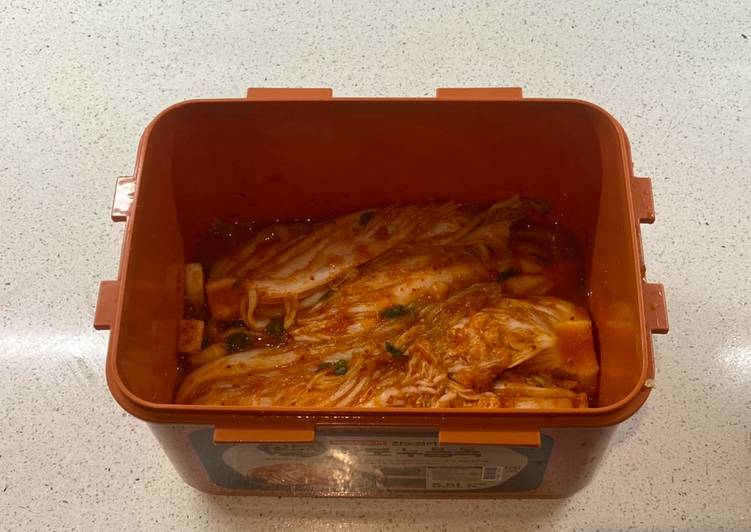
- Once it has been coated well place the that cabbage quarter into the large container or special kimchi boxes (that allow no air to escape). Or if making smaller portions cut the cabbage quarter across into two halves to fit better into the jar(s).
- Repeat the process until there are no more cabbage quarters and leave left to be pasted. Once the jars or containers are full, cover the top with cling film (to prevent air escaping which allows it to ferment better) and place the lid on top of the containers or close the jars.
- Leave the kimchi at room temperature in a cool place away from sunlight and heat. The fermentation process should begin 2 days later. Once it starts to ferment, bubbles will also appear (the bubble gives the taste of tanginess due to it making its own vinegar). Tip: It is ready in about a week and do not be tempted to open the jars or containers before then. Best not to open the kimchi before the week as it will affect the fermentation process.
- After the week is up the kimchi is ready to eat. To eat the kimchi for serving, take one quarter out of the container. Cut once down the middle lengthwise. Then cut across both halves a few times for bite size pieces. Or if using the kimchi from the jar place the kimchi does not need to be cut. Tip: The cabbage end is not served.
- Tip: Kimchi kept at room temperature, lasts 1 week after opening. In the fridge it stays fresh much longer and can be kept between 3 to 6 month as it continues to ferment, this can lead to a more sour taste. Fridge the kimchi after opening as warmer temperatures can spoil it quicker. Place kimchi on a serving plate. Eat and serve as a side dish with a bowl of steamed rice and other accompaniments. Or can even be eaten as a snack or make into a stew and soup.
Kimchi is a spicy side dish made from fermented vegetables and Korean red pepper, and is loaded with potential health benefits. It is a staple of the Korean diet, and its popularity has surged worldwide. Mak Kimchi, Cucumber Kimchi and Water Kimchi are some great easy ones that you can make at home. This easy Kimchi recipe will teach you to make authentic Kimchi (Kimchee) at home. It's easy to do with these simple steps!
If you find this Kimchi recipe valuable please share it to your friends or family, thank you and good luck.
![Easiest Way to Make Perfect Quick! [Turnip Salad with a Meaty Texture]](https://img-global.cpcdn.com/recipes/4656511673434112/751x532cq70/quick-turnip-salad-with-a-meaty-texture-recipe-main-photo.jpg)